

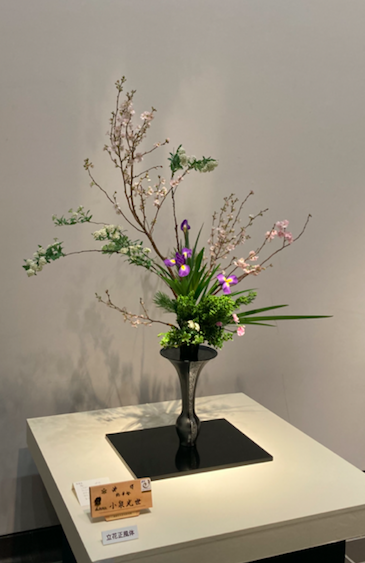
Are you interested in Japanese traditional cultures? You might know Japanese traditional Ikebana that is called “Kado”華道, (Japanese Art of Flower Arrangement).
If you flatter yourself that you are definitely a connoisseur of Japanese cultures, you should know the concept and philosophy of Kado.



You also know “Sado”茶道(Japanese Tea Ceremony)and Kodo 香道 (Incense Appreciation) which deeply related to Kado, those concepts depict sophisticated atmosphere, spatial arrangement in the space where is strained quiet loneliness and beauty of silence.
Basically, Ikebana used to adorn the tokonoma (alcove) in front of kakejiku(hanging scrolls) in Japanese traditional home.


There are various distinct schools of Ikebana in Japan. Frankly I can’t give a clear-cut explanation of the differences of them. Though, I just visited Ikenobo exhibition at Tokyo Metropolitan Art Museum, so I have learned a little about Ikenobo Kado.
There are estimated to be around over 3000 Ikebana schools in Japan, however, the largest and most popular schools of Ikebana are Ikenobo(池坊)、Sougetsu(草月)、Obara(小原).
The oldest Ikebana school is Ikenobo. It had begun at Muromachi-era by the monk who name is Ikenobo Senkei.
The characteristic of Ikenobo(池坊) is mainly represented these three ways of style,
“Rikka(立花)” ,”Shoka(生花)”,”Jiyuka(自由花)”, respectively.
Rikka(立花) is emphasized as means of the materials and forms as they existed in their natural state like sky, mountain, river. It is depicting landscape of nature from Muromachi-era.
Shoka(生花) is generally used one to three materials, which express vital nature of living of flowers and leaves, branches. It was established around Edo-era.
Jiyuka(自由花) is no crucial rules or forms of figures, just try to bring out the charm of their figures and textures.
Sougetsu(草月)is more an avant-garde style of school, which was established in 1927 by Teshigahara Soufu. It is known as free and modern art approach to Ikebana. It doesn’t follow to be bound by common traditional style.
Obara(小原) was established by Obara Unshin. He possessed to utilize for expressing his way of school by using western materials and forms in Meiji-era. He developed Moribana(盛花) style, which is composed of 3 dimensions of art works.
In general, Ikenobo(池坊) contributed to the development of rikka style. Considering this fact, Ikenobo is to the oldest Ikebana school in Japan.
Ikenobo’s basic concept is, representing the state of natures – plants and flowers just exist here profoundly. The view of the world is “Less is more”- as it were,”Wabi-Sabi”.

Ikebana reached its first zenith in the 16th century. And later, in the middle of Edo era, spread widely among common people.
In the Meiji-era, most of girls’ schools brought Ikebana classes in school as part of the mandate curriculum.


Even today, Ikebana is respected as one of the classical Japanese arts of refinement.
If you really would like to learn “Wabi-Sabi”aesthetics, this column below is one of the best descriptions about the concept.