Shodo(書道)-Calligraphy-expresses spiritual depth and beauty by means of Kanji and Kana-Chinese ancient poems and Japanese old saying.

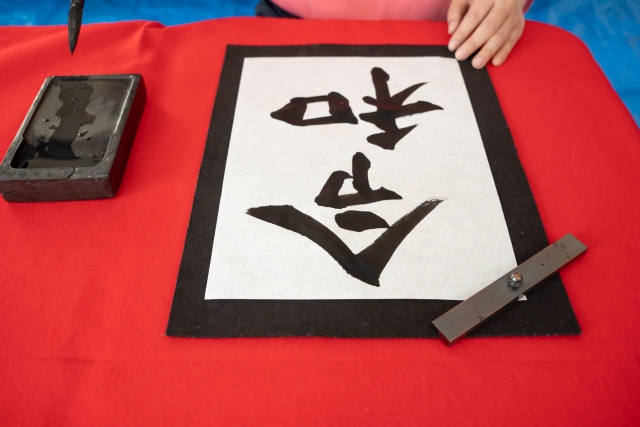
In my previous posting, I introduced that Japanese new year’s customs –Kakizome- the first writing of the new year with Japanese writing brush (fude 筆) and ink(sumi墨). People commonly write new year’s resolutions, auspicious words and poems for celebrating new year.
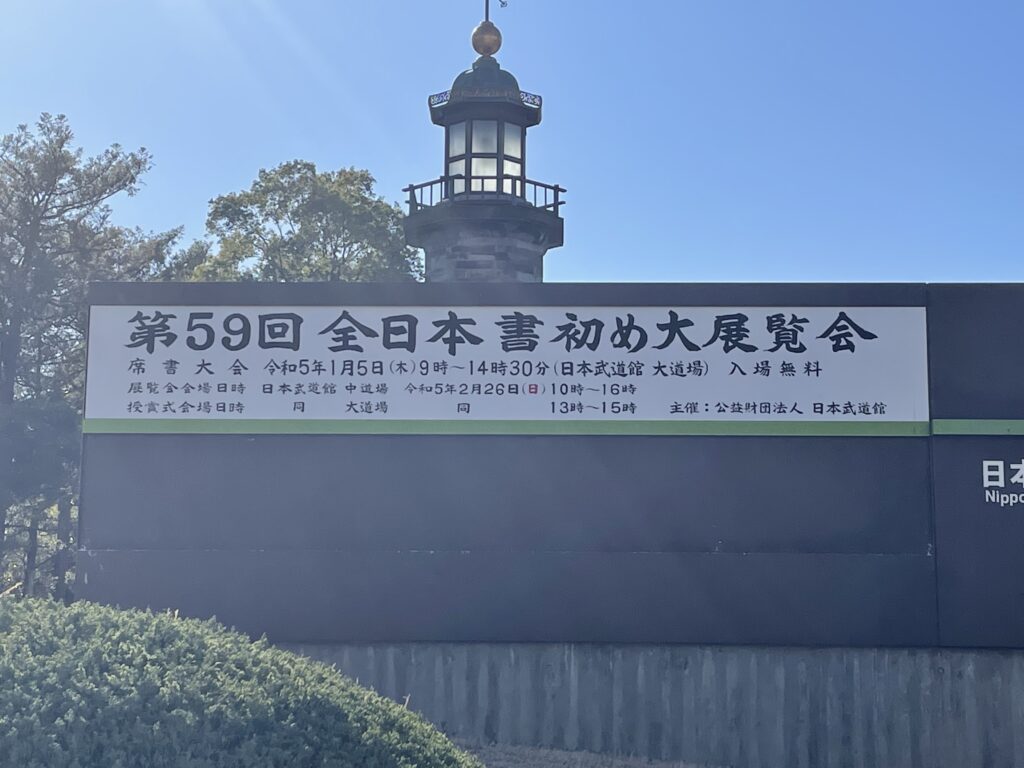
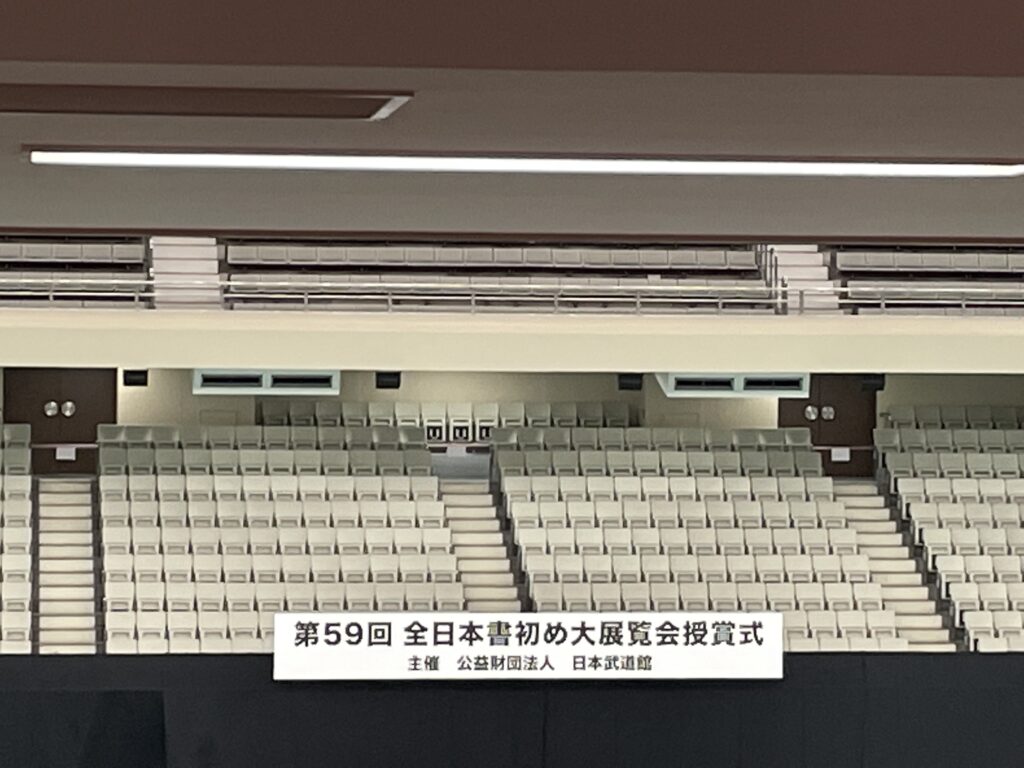
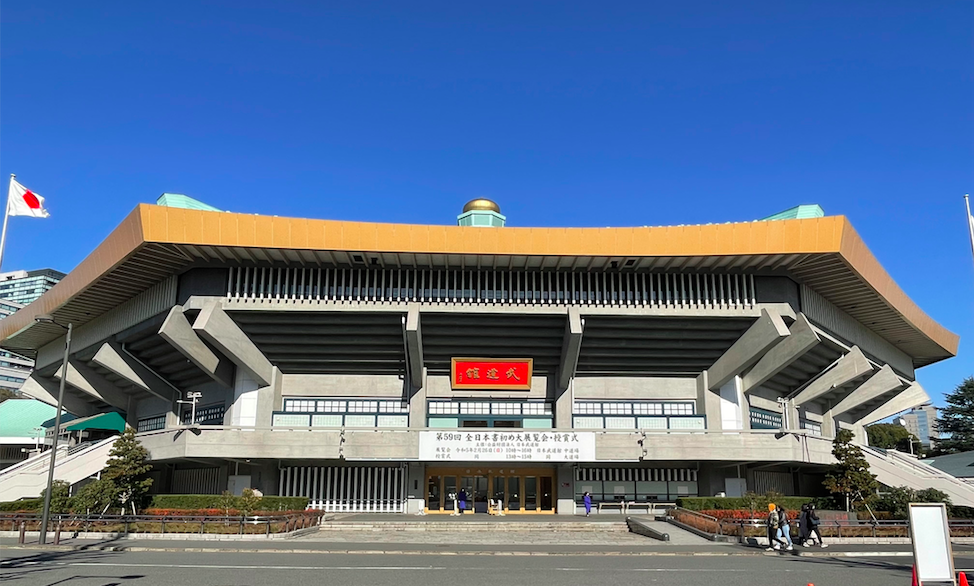
The 59th Kakizome competition and exhibition of Japan took place at Nippon Budokan in February 2023.

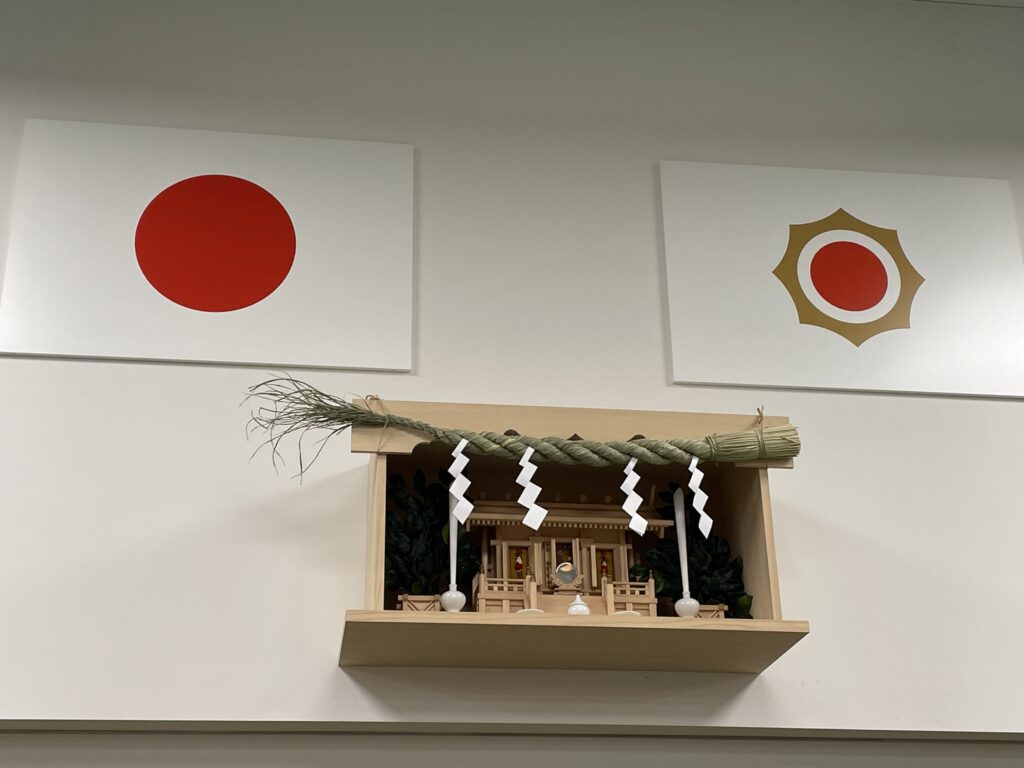
Nippon Budokan, maybe, no need to explain, the central organization hall for the promotion of Japanese Budo武道 (ex. Judo柔道, Kendo剣道, Kyudo弓道,Aikido合気道, Karate空手, Sumo相撲, and so on). Furthermore, it is also a well-known place where is legendary, prestigious live concerts hall. Famous musicians have been holding their live concerts at Budokan since 1964, like The Beatles, Cheap Trick, Kiss, Aerosmith, Eric Clapton, Guns N’ Roses, etc. (excuse me, I am a huge hard rock, heavy metal fan!)

http://nipponbudokan.or.jp/english

At that time, there was the award ceremony and an exhibition for the winners of 59th Kakizome competition.

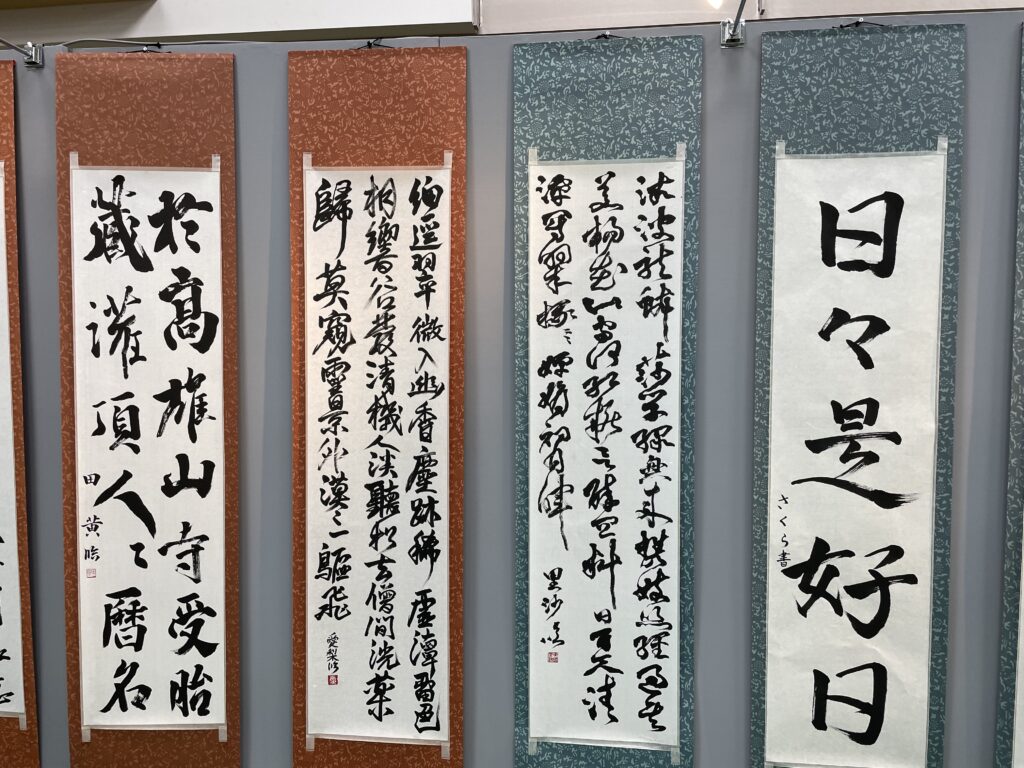
The appreciation of a work of calligraphy depends on the beauty of expression, theme selection, writing style, meaning of the words or poems.

Calligraphy has been more highly respected as an art in China, Korea and Japan for a long time, because of the complexity of the Kanji character. In Japan, They are often displayed at Tokonoma(Japanese alcove) as the main theme of Kakejiku.
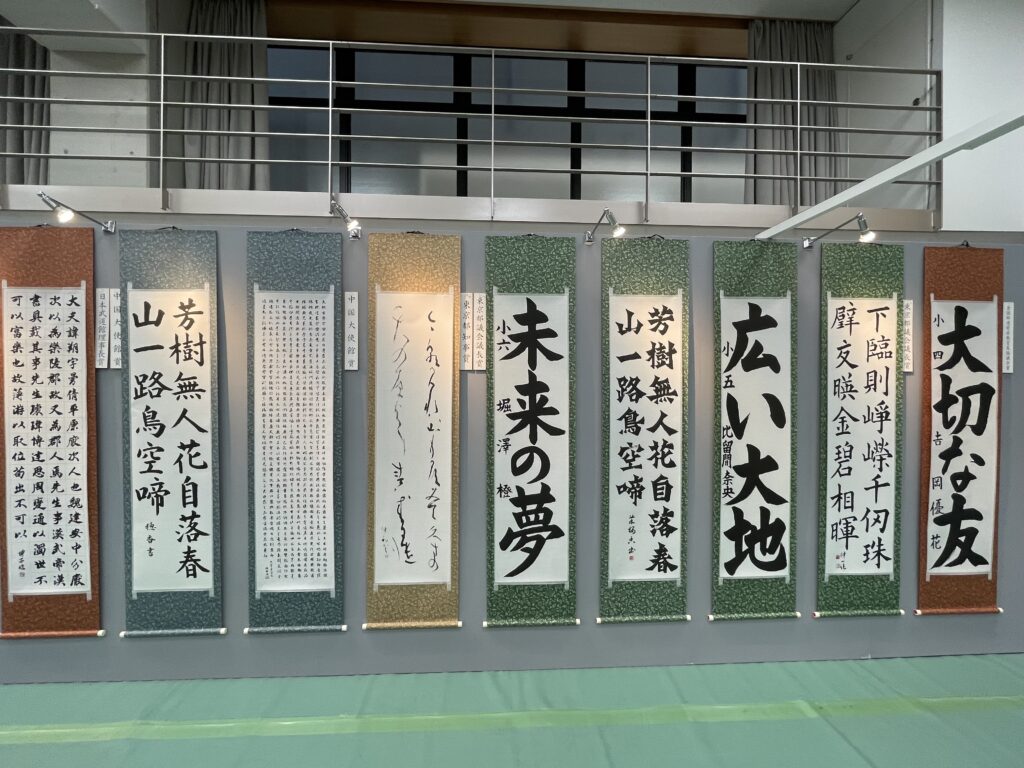
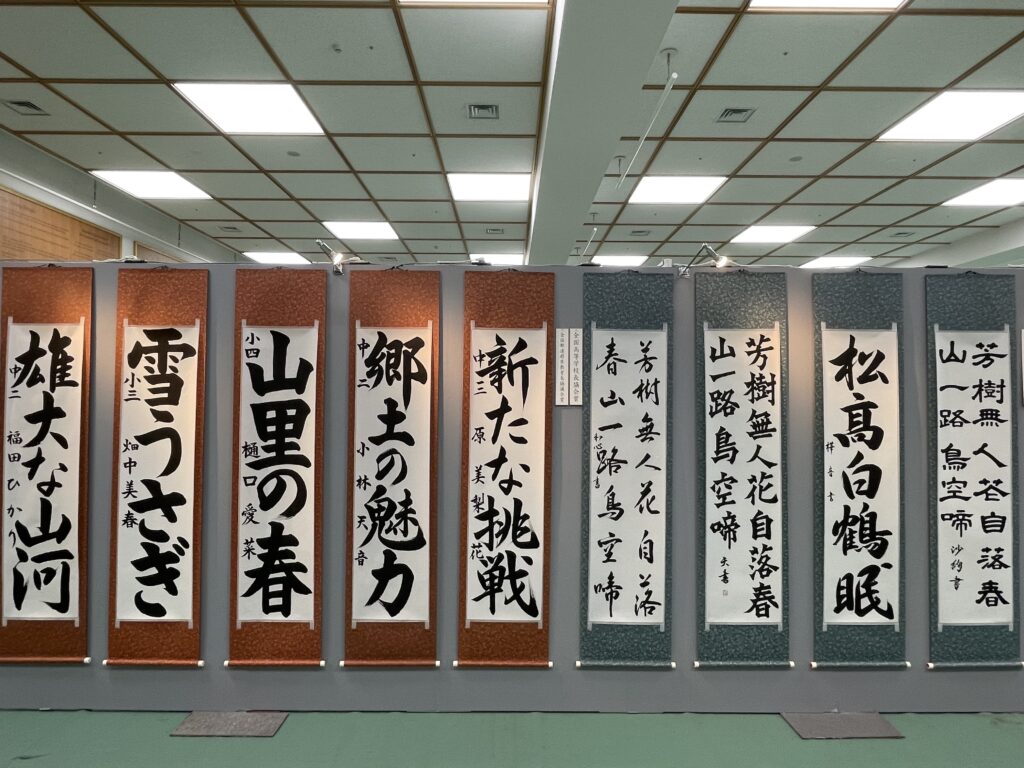
The awards judgement have been made by each sponsor like news paper companies, governmental organizations, cultural organizations, thief of municipals. The evaluation criteria is based on brush strokes, letter structure, gradation of light and shade of sumi, arrangement, letter alignment. Every letter should be unified as one worldview by using a one washi和紙(hanshi) 半紙paper,bunchin文鎮, suzuri硯, shitajiki下敷.

Shodo has basic 5 figures of writing Kanjis, 篆書(Tensho)、隷書(Reisho)、草書(Sosho)、行書(Gyosho)、楷書(Kaisho).
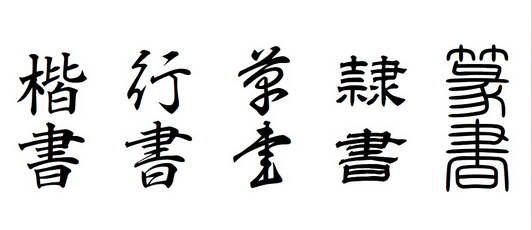
Kaisho, Gyosho, Sosho, Reisho, Tensho,

As I mentioned before, writers have a tendency to select new year’s resolutions, happy auspicious words, old Chinese poems, Japanese old proverbs for their writing themes.
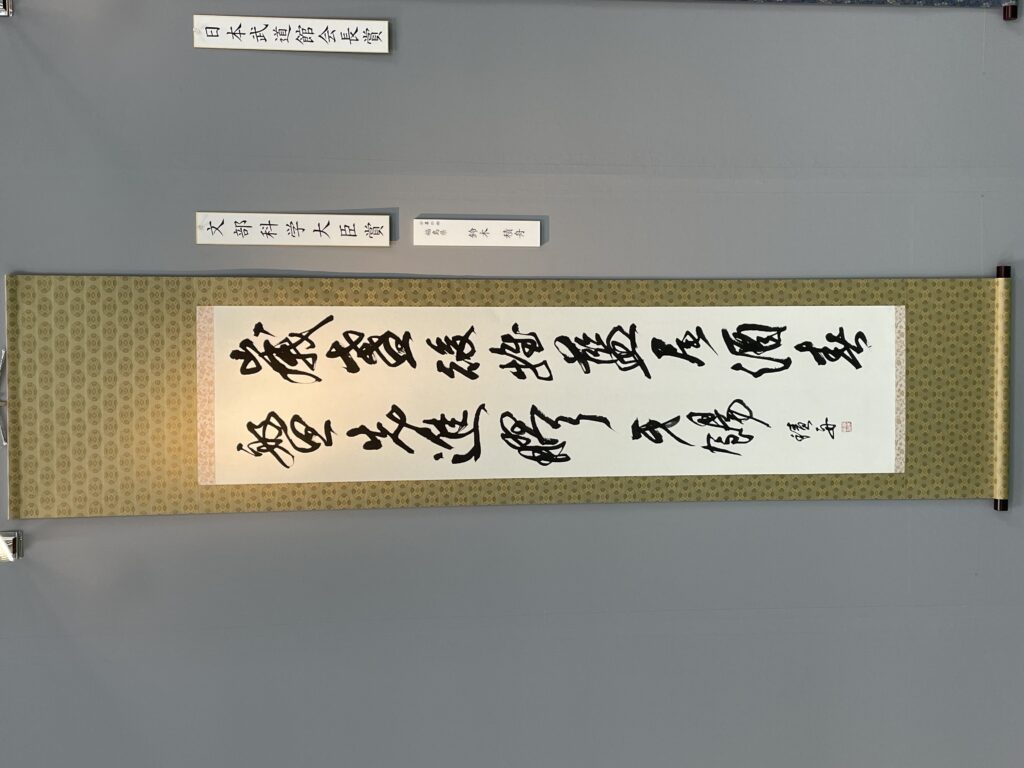
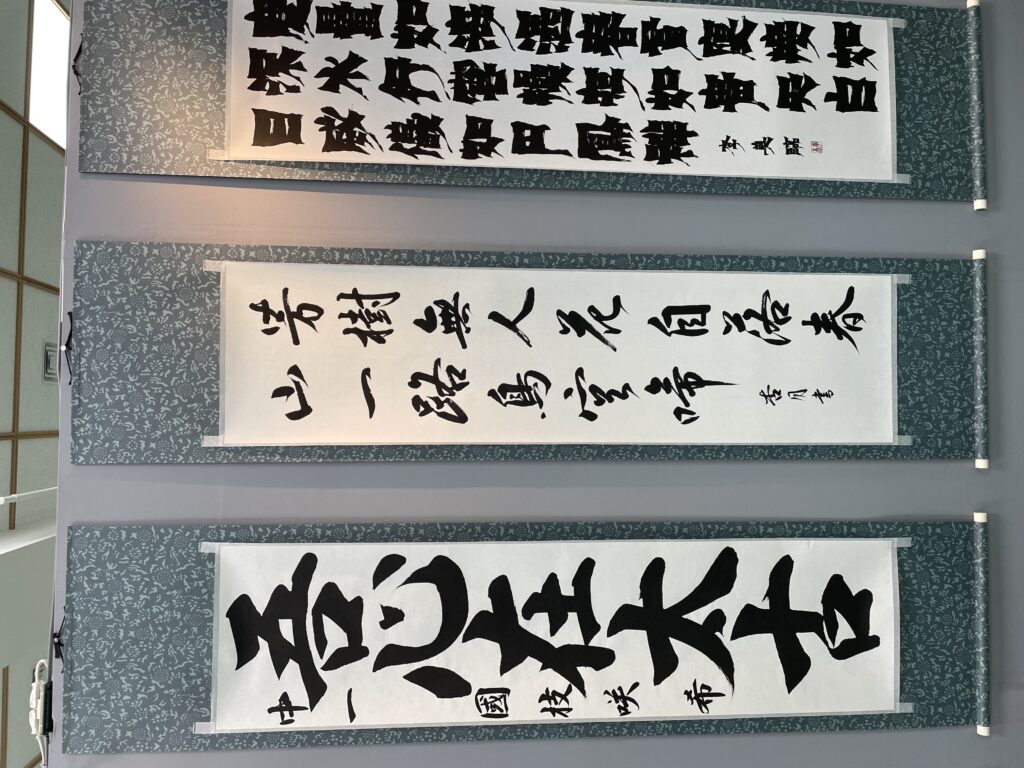
Everyone feel happy for watching Childrens’ kakizome in January.

Also, I was really impressed when I stood in front of artistic shodo works by professionals, even amateurs, those shodo works were…beyond description!
Japanese tea ceremony – the spirit of “Omotenashi”

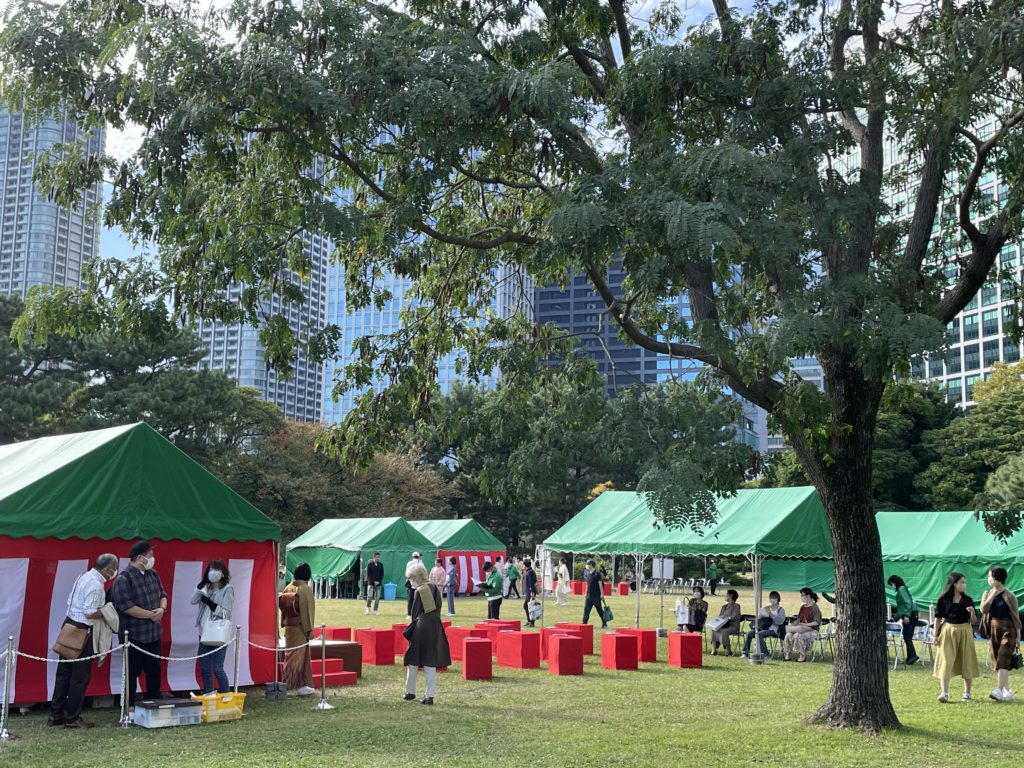
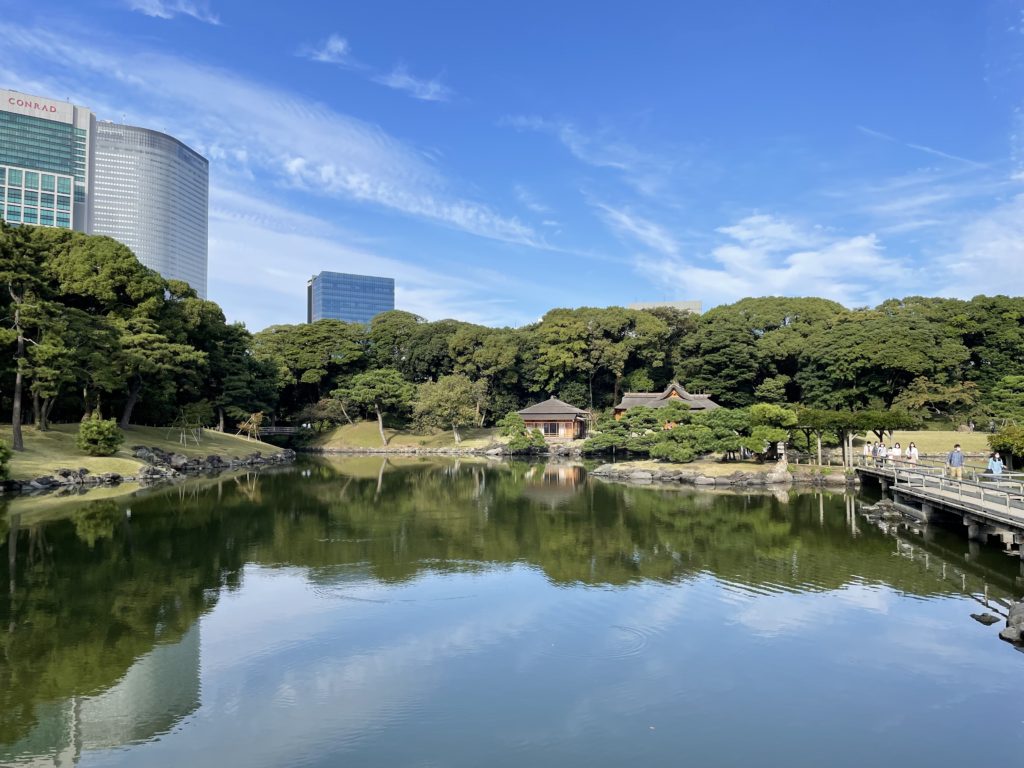
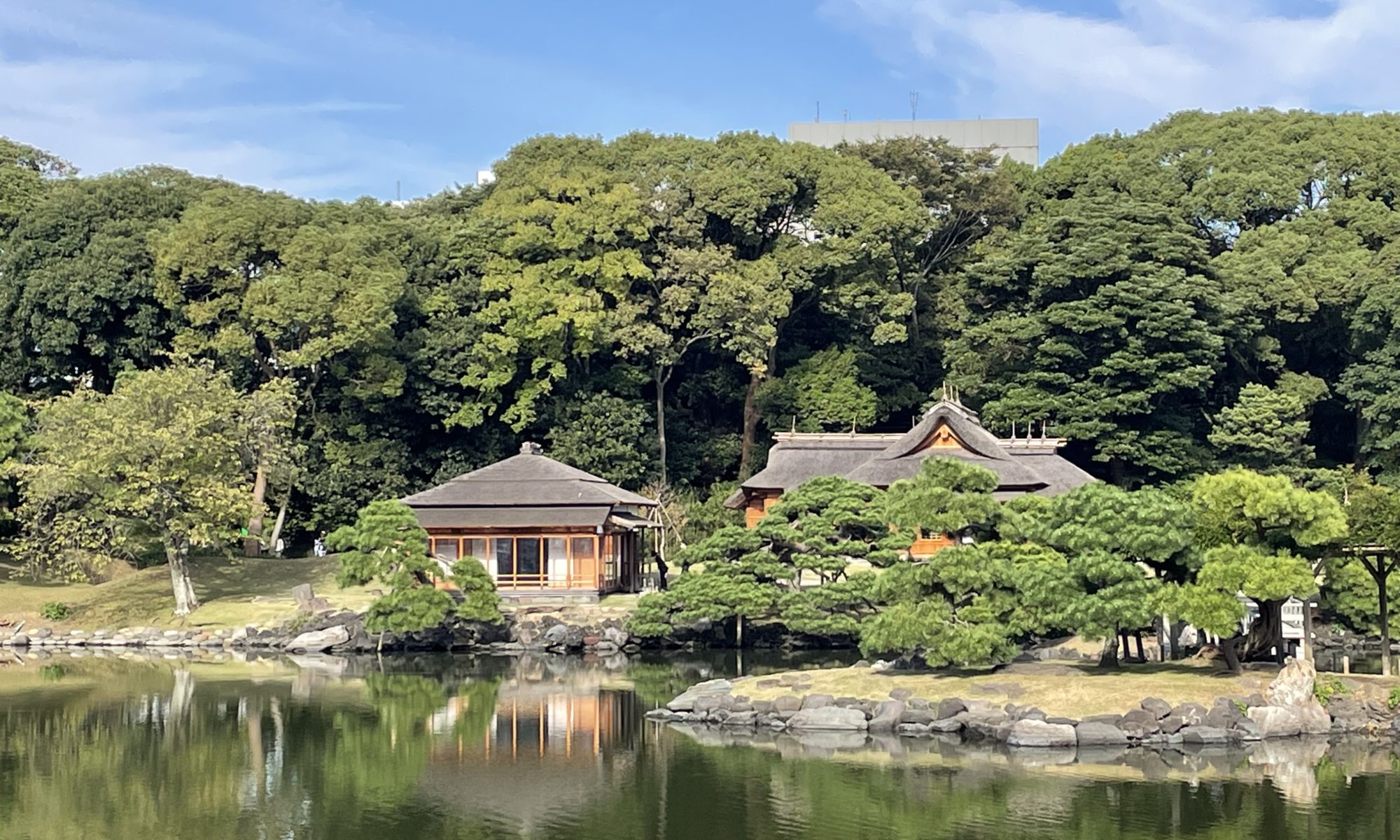
Tokyo Grand Japanese Tea Ceremony was held in Hama Rikyu Gardens on October 2022. It had been held on regular basis from 2020, then the first time ceremony in three years after 2 times cancellations due to covid-19 pandemic.

Tea ceremony – it is called “Sado” “Chanoyu” in Japanese, we have no choice but to mention – “The Book Of Tea” – originally written by Okakura Tenshin in English. The book is very famous in western countries, literally, it is still playing an important role in introducing Sado’s background and philosophy. The book is also very useful guideline for beginners who would like to know the heart of Chanoyu or knowing Japanese esoteric culture and history.

Basically, the event was divided into four programs and areas.

1. Tea ceremony (Indoor)

2. Outdoor tea ceremony (called Nodate in Japanese)

3. Outdoor tea ceremony by high school student.

4. Indoor tea ceremony in English

Pre-registration tickets were available in the website below,

https://tokyo-grand-tea-ceremony.jp/en/index.html

Walk-up tickets were limited available in case of having seat cancellations.

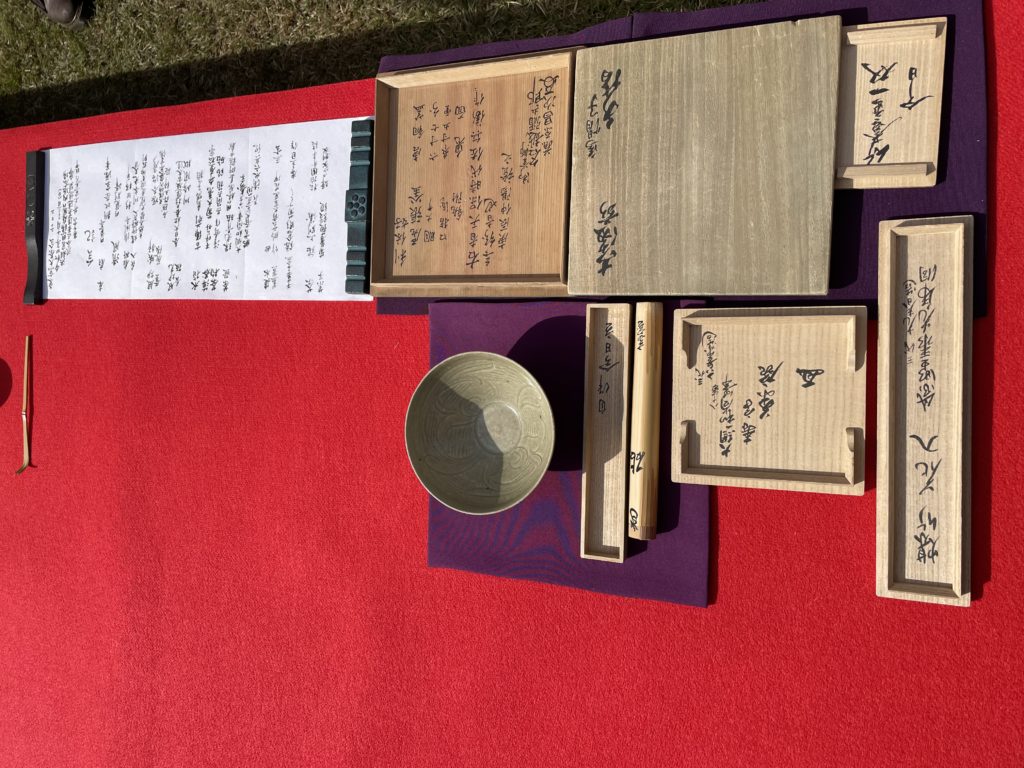
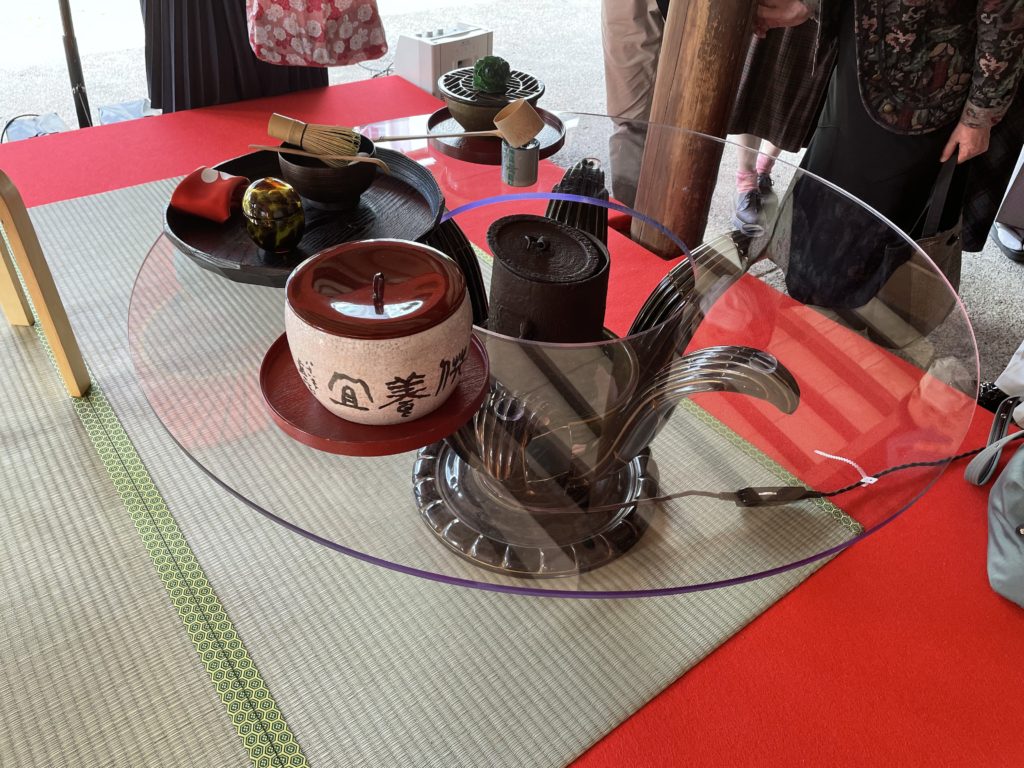
”Cha-Dougu” 茶道具 Tea utencils

The participants will definitely enjoy the world of “Chanoyu” with a cup of green tea (Maccha) and Japanese traditional sweets (Wagashi) only 500 yen!

It is no wonder if you might be a little bit scared to participate in tea ceremony for the first time, frankly, even I am a Japanese, still felt like “having a high threshold” for formal Chanoyu entry because it has strict manners to share same atmosphere and space with the host and other guests.

However, this event is largely open for Chanoyu beginners who are just interested in Japanese Tea Ceremony and Japanese gardens and culture, also Nodate(outdoor tea ceremony) is more casual tea ceremony party so you can join them with ease.

They will hand out brochure, which gives you the basic instruction of tea ceremony. So don’t worry! You don’t hesitate to join them!

”Nodate”野点 Tea ceremony (Outside)

The instruction of tea ceremony – quoted from Tokyo Grand Tea Ceremony 2022 brochure. The ceremony carries on like this.

  • Guests should remove watches and accessories such as rings and bracelet before entering the tearoom, so as not to damage the tea container and utensils.
  • It is said that as a general manner, guests should wear white socks or tabi, and bring along “kaishi” paper and picks used for eating wagashi Japanese sweets.
  • Manners may differ between tea schools. Please listen carefully to the commentary of teacher and put it in practice.
  1. When wagashi Japanese sweet are served, you say : “Osaki-ni (pardon me for going ahead)” to your neighbor, transfer a wagashi to the “kaishi” paper  in front of you, pick wagashi are eaten before the drinking of the tea.
  2. When tea is served, you say : “Osaki-ni (pardon me for going ahead)” to your neighbor, put the tea bowl in front of you and bow to the host. You take it in your right hand, place it on the palm of your left hand and raise it slightly with gratitude. With the front of the bowl toward you, rotate in twice to avoid drinking from the front, and then drink all the tea in a few sips.
  3. When you have finished drinking, use the thumb and index finger of your right hand to lightly trace the part of the tea bowl rim from which you drank, and then wipe your fingers with a “kaishi” paper.
  4. Then turn the bowl back twice so that the front faces you and place the bowl in front of you.
  5. After looking at the tea bowl in appreciation, turn it with its front towards the host.
Tea ceremony in English

The Sado or Chanoyu – is traditional Japanese way of drinking tea in accordance with set rules of etiquette. the point is – both the host and guests  share a sense of togetherness during the ceremony.

The Chanoyu was mostly perfected by Rikyu Sen in the Azuchi-Momoyama period in the latter half of the sixteenth century.

As it were, the core of “heart of Chanoyu” is felling the hosts’ hospitality – they always take utmost care in the preparation of their tea rooms, the adjacent garden, tea utensils and the provision of simple dishes for the exquisite tea room.

The tea ceremony etiquette has been influenced by the etiquette observed by the samurai classes as well as by the form of Noh dances. In turn, the tea cult had a great influence on traditional Japanese customs and manners.

Japanese hospitality – sometime calls “Omotenashi” in Japanese is a part of  Chanoyu, which also represents sense of Chanoyu sprits from Rikyu.

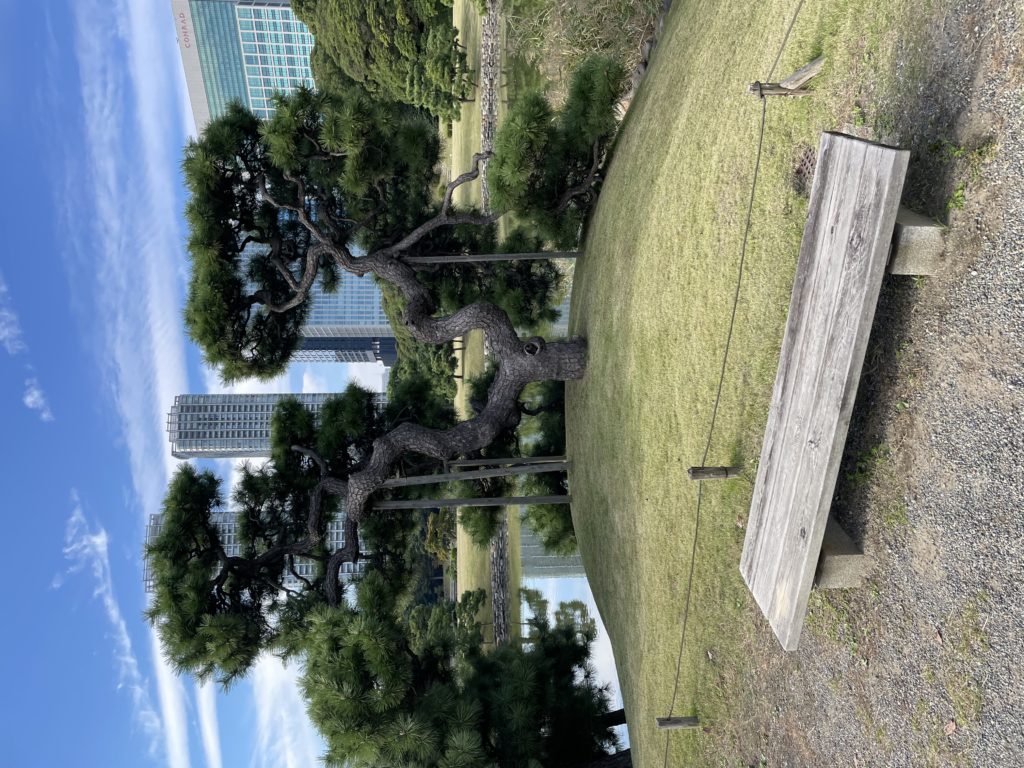
Hama-rikyu Gardens

https://www.gotokyo.org/en/spot/20/index.html

Japanese traditional New Year’s events -Shogatsu-正月- The most important holiday in Japan – how to spend New Year’s holidays!

In the western countries, the most important holiday is Christmas. People celebrate and spend special time with their family members. Japanese people also go back to their hometown in the end of December and spend Shogatsu (正月)holiday until the first few days of January.

To the contrary to the western countries’ Christmas celebrations, the most important holiday in Japan is the New Year’s Day that is called “Shogatsu”.

New Year’s events already begin at the New Year’s Eve. Commonly they eat soba noodles, which is called “Toshikoshi soba” for preparing and celebrating the New Year, While listening the sound of temple’s bells “Jyoya no kane”.

In the morning of Shogatsu, they open jyu-bako bento box. “Osechi Ryori”(お節料理) is hors d’ oeuvre – a set of fortune cuisines. Every ingredient has characteristic meaning. Japanese people taste and enjoy these meals for praying New Year’s fortune and happiness, family member’s health, well-being.

Jyu-bako bento box is full of Osechi Ryori. As I mentioned before, every cuisine has each meaning, for example, it is nothing but a rhyme,

Kuro mame(black beans) – means “mame ni kurasu” (live diligently).

Meanwhile, some dishes were selected, in favor of their figures or colors.

Kazunoko (herring roe) – many eggs of herring – hopes “shison hanei” (descendants prosperity).

Kurikinton (mushed sweet potatos & chestnuts) – indicates “okane” (raise money, gold from its golden color).

Ebi (shrimp) – hopes live longer until their backs are curved (get old) like shrimps.

Zouni(雑煮)is commonly cooked baked rice cakes with some vegetables and fish cakes in broth soup of soy source or miso. Tastes are different in each region.

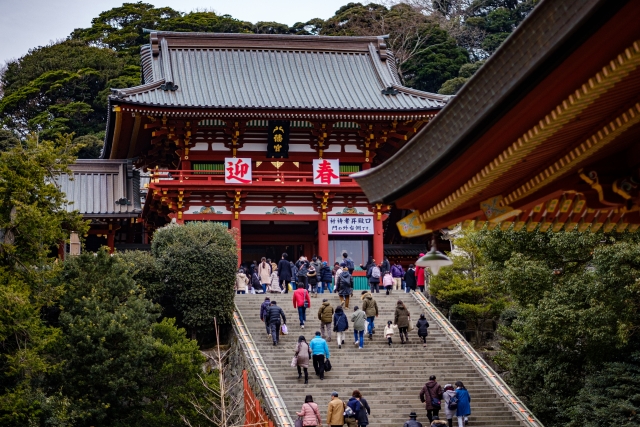
They often visit shrines or temples to make a wish and pray for the good fortune of the New Year. It is called Hatsumoude(初詣). Some people watch the sunrise from ocean or mountain.

At the same time, Japanese people send postcards(Nengajyo 年賀状) to their relatives, friends, colleagues as New Year’s greeting. It’s basic manners to be delivered to addressees until a few days of new year’s day even if belated.

Japanese children often receive some money in a small envelope (pochi-bukuro) from their parents and relatives. That is called “Otoshidama” .

While spending their relaxing, fun time with their family members, often we play traditional New Year’s games as below,

Takoage(凧揚げ)- means flying a kite. Typical kite design is traditional Japanese Ukiyoe (浮世絵), and people selects happy design to celebrate new year.

Kakizome, Shodo(書き初め,書道)-the first writing of the new year with Japanese writing brush, Fude(筆)and Sumi(墨). People write their new year’s resolutions, positive words in calligraphy by using a Japanese Shitajiki(下敷), Bunchin(文鎮), and Washi paper (和紙).

Karuta(カルタ)-Japanese playing cards are two sets of cards – reading part and picking part. Participants of the game try to pick the correct card while the partner card is chanted.

The most popular set of cards is “Hyakunin Isshu” that had been selected 100 famous poems from the 8th to the 13th century.

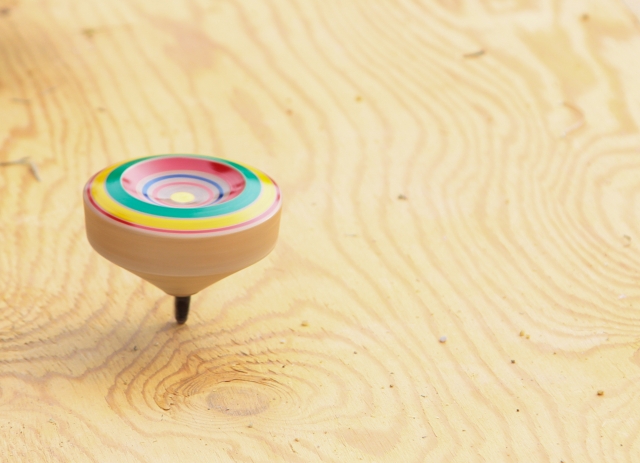
Koma-mawashi(独楽回し)- A game of top-spinning. Players try to spin fast their own spinning top on the ground. The longest spinning one will be the winner.

Hanetsuki(羽根突き)- Hanetsuki is similar to badminton game. But it uses a shuttlecock and a wooden paddle, which is drawn Japanese traditional picture by using bright colors.

There are many other regional, local events and plays in Japan.

Let’s go out and find out something new!

“Learn from the old, know the new”

Traditional Japanese musical instruments – for authentic Japanese music

If you are a genuine music lover – especially, like digging into local folk music all around the world,there is no loss in you knowing these 5 musical instruments that will be introduced below. Generally, these have been playing with Japanese traditional songs such as Soukyoku, Nagauta, Minyo, Kouta, Youkyoku for hundreds years in Japan.

Generally, music – as in most other nations, evolves from a form of religious celebration and sometimes having a ceremonial role, to becoming a form of entertainment.

Traditional Japanese music is classified by period of origin into Gagaku(ancient), Nogaku(medieval) , and the music of the Shami-sen and Koto(resent). At the same time, the Shakuhachi commonly played by buddhist monks, and the Biwa was known as blind men’s typical work. They called “Biwa-Houshi” who had kept moving place to place in the medieval era of Japan.

Soukyoku(箏曲) is the general name for music played on the Koto. This musical form which developed in the late sixteenth century, later came to be played in concert with the Shami-Sen and the Shaku-hachi.

Nagauta(長唄) is a kind of long epic song based on Shami-sen music which evolved together Kabuki (歌舞伎)dancing in the late seventeenth century.

Having absorbed the lyrics and melodies of local folk music are Minyo(民謡). Minyo is worker’s songs used to sing during their day-to-day works and activities.

Kouta (小唄)is a form of short song or ditty which appeared in the early nineteenth  century that is sung at a quick tempo in a suppressed voice.

Youkyoku (謡曲)is the singing to which Noh plays are performed and, is itself the main script of a Noh (能)play. Also Noh is performed independently. Those Noh music was mainly composed between fifteen and sixteenth centuries by Kan-ami and Zeami.

Meanwhile, musical instruments were able to bring additional excitement to ordinary people’s special seasonal events like Bon-Odori(盆踊り), or Matsuri(祭) (local folk festivals typically hold in summer or fall).

Here’s a quick guide to 5 Japanese musical instruments – that always make people’s heart pound throughout in Japan!

Shami-Sen

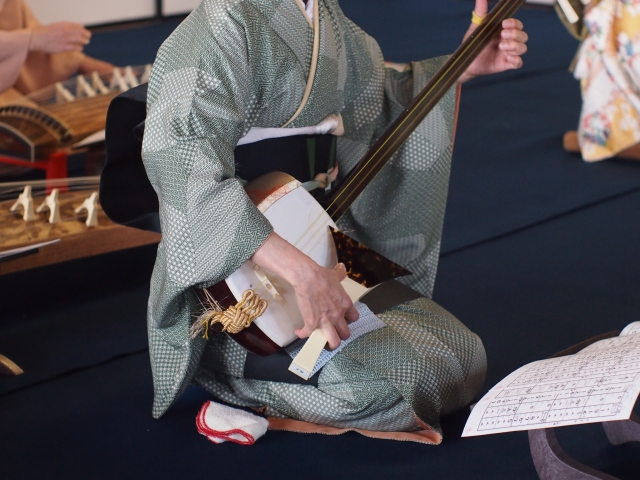
Shami-Sen(三味線) means “three strings”. Shami-sen has some regional variations like Okinawan “San-Shin”. Aomiri’s “Tsugaru-Jyamisen). Those musical sounds reflect on local climates and atmosphere, peoples’ characters of each region.

Shami-Sen has no frets, but can play same way like a guitar. Sometimes a player of Shami-Sen and Geisha(Traditional Japanese Dancer) or Maiko(younger one of Geisha) are invited to special tatami room(Ozashiki) of Ryotei(exquisite traditional Japanese restaurant) and perform Shami-Sen and traditional Japanese dance in front of Ryotei guests.

Biwa

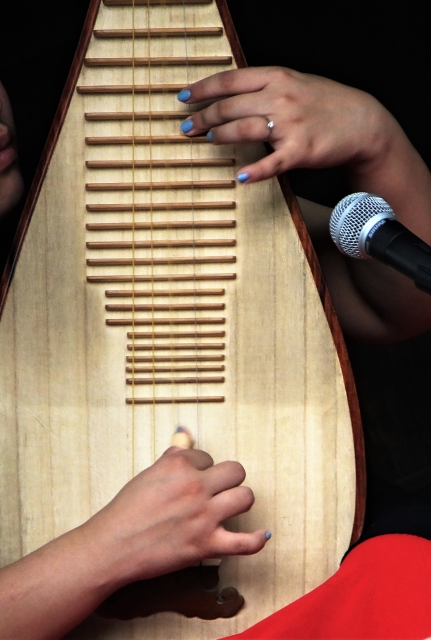
Biwa(琵琶) is a short-necked lute has commonly three to five strings. The difference of Shami-sen and Biwa is, Biwa has four to six frets and play vertically with a large plectrum – is called Bachi(like a pick). Biwa used to play by Biwa-Houshi (traveling Biwa players) in tenth century.

Biwa is still used in Gagaku(雅楽)(traditional Japanese court music) since seventh century. Gagaku makes very “refined” impression on the listeners even Japanese themselves.

Koto

Koto(琴) is national instrument which comes in two types of 13 strings and 17 strings. Koto is basically placed on the ground with tatami mat, and play with Koto-zume(琴爪) . Koto has a long body up to 180 cm(around 6 feet), Koto players hunch over the instrument and pick at each string with Koto-zume. Some say Kotos’ sounds very moody and authentic.

Koto is one of the representative musical instrument of Japan. Koto’s notes – remind Japanese people of New Year’s day’s “same old song”.

Shakuhachi

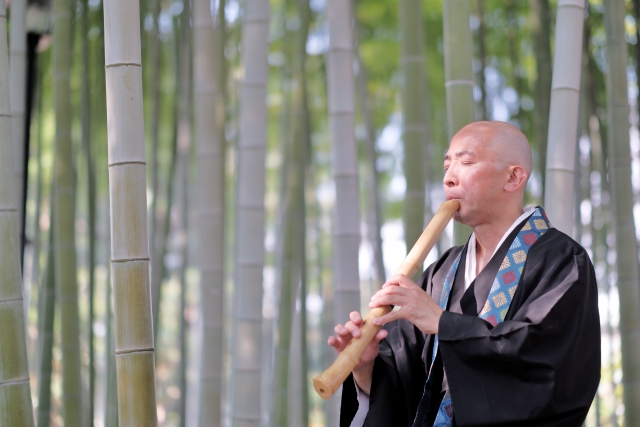
Shakuhachi(尺八)used to play by Japanese Zen buddhists and monks. Shakuhachi figures like a flute, but plays vertically. Shakuhashi has four holes on the front and one hole on the back.

Shakuhachi is made of bamboo. The sound is very quaint, but always plays important role for Japanese music orchestration.

Taiko

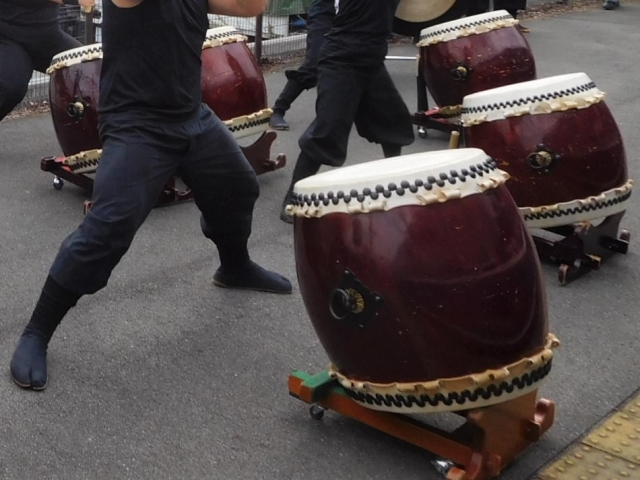
Taiko is Japanese drums – typically play at Japanese Bon-Odori (summer festival) or treated the background music during Matsuri(seasonal festival) have been held anywhere in Japan since long long ago.

Taiko(太鼓),formally called Wa-Daiko(和太鼓) has many sizes and shapes.

Wa-Daiko sounds are very vigorous and valiant courage.

Wa-daiko often plays by using Bachi sticks and sometimes collaborate with other traditional Japanese musical instruments – same as western music bands.

Listening to traditional Japanese instruments will broaden your horizon, then, give you absolutely new perspective on Japanese culture!!

G.O.A.T! One of the best city pop song of Japanese 80’s. TV animes of Showa-era.

G.O.A.T! One of the best city pop song of Japanese 80’s and TV animes!

If you are really proud of yourself as a huge fun of Kadomatsu Toshiki, Otaki Eiichi, Yamashita Tatsuro, Takeuchi Maria, Anri…Yellow Magic Orchestra (Y.M.O). Everyone over here please! 80’s city pop, techno pop lover, you must love these tunes below!

Including a song, which is 80’s city pop-esque!! 🙂

If you’re planning to dig in vinyl records of 80’s city pop, stop by Darumaya or Disk Union in Tokyo and its suburbs. They have treasure troves of Japanese Showa-era music.

https://darumaya.to

https://diskunion.net

People might say, the most famous anime song of 80’s is “Theme of Lupin The Third”(instrumental). Or “Get wild – Theme of City Hunter” by TM Network.

But don’t forget this one, the ending song ”Miraikeisatsu Urashiman”, which is 80’s TV anime, not only coolest techno pop (technology pop) song but also 80’s TV anime song of Japan! It is still brilliant even in 2022! No joke!

Although, I could hardly remember how the story goes, OK, ask wiki! Ta-dah….the story background set at Tokyo in 1983.

While the boy(Urashiman) has been chased by cop cars from episode 1 opening sequence, finally he got lost in parallel world with sudden thunder strike and forced himself to travel through time… time warp…eventually he arrived the neo-futuristic world in 2050.

This song titled “Dream City Neo-Tokio” as it means he exactly showed up Tokyo city in 2050.

He was called “Urashiman” who is lost himself and his name, memories of the past. After being captured by future cops, he became a detective to investigate the mystery of his situation, he started finding himself. Who is the enemy?

If you have interest into it, please check Showa anime “Miraikeisatsu Urashiman”!

Japanese Ikebana – emerges small universe – the aesthetics of “beauty in the flaws”.

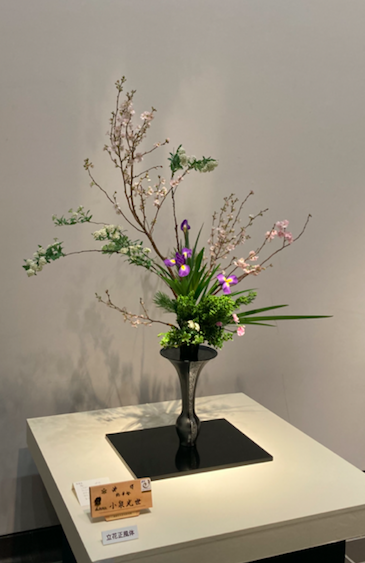
Shoka-Shinputai 生花新風体

Are you interested in Japanese traditional cultures? You might know Japanese traditional Ikebana that is called “Kado”華道, (Japanese Art of Flower Arrangement).

If you flatter yourself that you are definitely a connoisseur of Japanese cultures, you should know the concept and philosophy of Kado.

Rikka-Shofutai 立花正風体
Rikka-Shinputai 立花新風体
Tate-Bana たて花

You also know “Sado”茶道(Japanese Tea Ceremony)and Kodo 香道 (Incense Appreciation) which deeply related to Kado, those concepts depict sophisticated atmosphere, spatial arrangement in the space where is strained quiet loneliness and beauty of silence.

Basically, Ikebana used to adorn the tokonoma (alcove) in front of kakejiku(hanging scrolls) in Japanese traditional home.

Sanshu-Ike 三種生

There are various distinct schools of Ikebana in Japan. Frankly I can’t give a clear-cut explanation of the differences of them. Though, I just visited Ikenobo exhibition at Tokyo Metropolitan Art Museum, so I have learned a little about Ikenobo Kado.

There are estimated to be around over 3000 Ikebana schools in Japan, however, the largest and most popular schools of Ikebana are Ikenobo(池坊)Sougetsu(草月)Obara(小原).

The oldest Ikebana school is Ikenobo. It had begun at Muromachi-era by the monk who name is Ikenobo Senkei.

The characteristic of Ikenobo(池坊) is mainly represented these three ways of style,

 “Rikka(立花)” ,”Shoka(生花)”,”Jiyuka(自由花)”, respectively.

Rikka(立花) is emphasized as means of the materials and forms as they existed in their natural state like sky, mountain, river. It is depicting landscape of nature from Muromachi-era.

Shoka(生花) is generally used one to three materials, which express vital nature of living of flowers and leaves, branches. It was established around Edo-era.

Jiyuka(自由花) is no crucial rules or forms of figures, just try to bring out the charm of their figures and textures.

Sougetsu(草月)is more an avant-garde style of school, which was established in 1927 by Teshigahara Soufu. It is known as free and modern art approach to Ikebana. It doesn’t follow to be bound by common traditional style.

Obara(小原) was established by Obara Unshin. He possessed to utilize for expressing his way of school by using western materials and forms in Meiji-era. He developed Moribana(盛花) style, which is composed of 3 dimensions of art works.

In general, Ikenobo(池坊) contributed to the development of rikka style. Considering this fact, Ikenobo is to the oldest Ikebana school in Japan.

Ikenobo’s basic concept is, representing the state of natures – plants and flowers just exist here profoundly. The view of the world is “Less is more”- as it were,”Wabi-Sabi”.

Ikebana reached its first zenith in the 16th century. And later, in the middle of Edo era, spread widely among common people.

In the Meiji-era, most of girls’ schools brought Ikebana classes in school as part of the mandate curriculum.

Rikka-Shinputai 立花新風体

Even today, Ikebana is respected as one of the classical Japanese arts of refinement.

If you really would like to learn “Wabi-Sabi”aesthetics, this column below is one of the best descriptions about the concept.

Japan’s Unusual Way to View the World

The origins of Japanese comic strip that is commonly called “Choju-Giga” a set of four picture scrolls(Emakimono), in the mid -12th century.

Have you seen this very famous Emakimono (Scroll of Frolicking Animals and Humans)? I am sure that this caricature art works you can find everywhere in Japan. Especially mangas and animes, industrial designs, which have frequently collaborated with several art works.

The set of four picture scrolls, which are composed of “Koh-kan”甲巻、“Otsu-kan”乙巻、“Hei-kan”丙巻、”Tei-kan”丁巻、belong to the Kozan-ji Temple in Kyoto.

The scrolls are entrusted to the Kyoto National Museum and Tokyo National Museum nowadays.

“National Treasure, All About Choju-Giga” exhibition took place late spring in 2021 at National Tokyo Museum. So I visited the museum at Ueno Park, Tokyo.

Koh-kan 甲巻

All four volumes of  “Frolicking Animals” have been passing on the lively activities of anthropomorphized animals and ordinary people life in 12 – 13 centuries with energetic ink lines to our generation in 21 century.

All scenes flow from right to left, you can find quite a few animals inside this Emakimono, especially volume 1,“Koh”甲巻, most famous one, which covers a wide range of animal characters such as hares, frogs, deer, monkeys, cats, wild boars, horses, bulls, foxes and so on.

Koh-kan 甲巻

Some of them are bathing, playing sumo, praying monkey with monk robe to frog budda, deer ride, catch and run…animals are so cute and funny, fresh, vigorous!

They seem to be about to come out of the screen!

Koh-kan 甲巻

No wonder the works still keep inspiring many modern artists. It is no exaggeration to say that the origin works of Japanese mangas and animes.

There is many poultries, and imaginary animals, which were believed to exist in China until late 15 century, emerge in volume 2“Otsu”乙巻.

Otsu-kan 乙巻

In addition, volume 3 ”Hei”丙巻depicts the lives of ordinary people lively, their activities, playing and gaming scenes in downtown. The volume 4 ”Tei” 丁巻draws monks and people are playing sumo and enjoying horse ride, watching an itinerant performer with orchestra in the street.

Hei-kan 丙巻
Tei-kan 丁巻

The Chances are that you can encounter upcoming exhibitions while visiting Japan, or watch digital archives at the museum site.

https://kosanji.com/chojujinbutsugiga/

https://en.wikipedia.org/wiki/Ch%C5%8Dj%C5%AB-jinbutsu-giga

https://www.tnm.jp/modules/r_free_page/index.php?id=2009

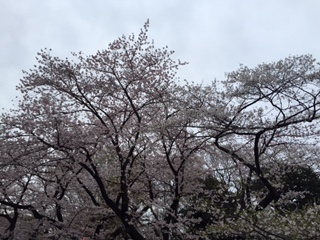
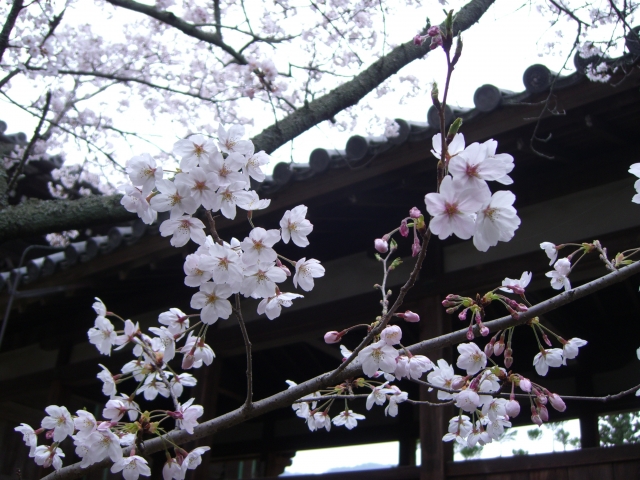
Cherry Blossoms : The Symbol of the Japanese Spring and the Start of the New Year

The majority of Japan’s companies and schools begin in April. In comparison to most other countries that start new years in September, a large difference is felt.

Most of the Japanese have willingly accepted this. Of course, it is still an inconvenience to those that wish to attend half-year camps overseas or study abroad. In order to adapt to these challenges, many Japanese colleges and universities have started allowing transfers or enrollments starting in September.

Despite the differing new years, I believe starting a new year as the cherry blossoms and other spring flowers bloom is good for the soul. It is truly the start of a new life, a new path and a new you.

Visiting Japan’s national flowers; the cherry blossoms, is a great thing to do as a tourist.

There are several great cherry blossom sites just in Tokyo, including the Imperial Palace (皇居), Chidori-ga-fuchi (千鳥ヶ淵), Askayama Park (飛鳥山公園), Shiba Park (芝公園) and the Hamarikyuu Gardens (浜離宮恩賜庭園) ,Meguro River(目黒川),Yasukuni Shrine (靖国神社),Shinjuku Gyoen National Garden (新宿御苑). The cherry blossoms are especially beautiful at night when lit up by the Roppongi Ark Hills (六本木アークヒルズ). Located in a relatively traffic-free spot right in the middle of Tokyo, this soothing rest stop is a hot spot for tourists in Tokyo.

To the high snowfalls of Hokkaido to the everlasting summers of Okinawa, Japan is a country where sightseeing is possible and tourism is a year-round possibility. For example, in Tokyo and other eastern regions, it is possible to enjoy beautiful sceneries all year long. Japan is definitely not just a country of video games and anime. If the 2D world becomes too monotonous, simply pay a visit to some of Japan’s ancient and healing natural environments.

To those starting to study overseas in Japan, and to those considering working in Japan, I believe the changing of the seasons can heal the weariness of our busy everyday lives. During your stay in Japan, please enjoy the Japanese culture and way of life.

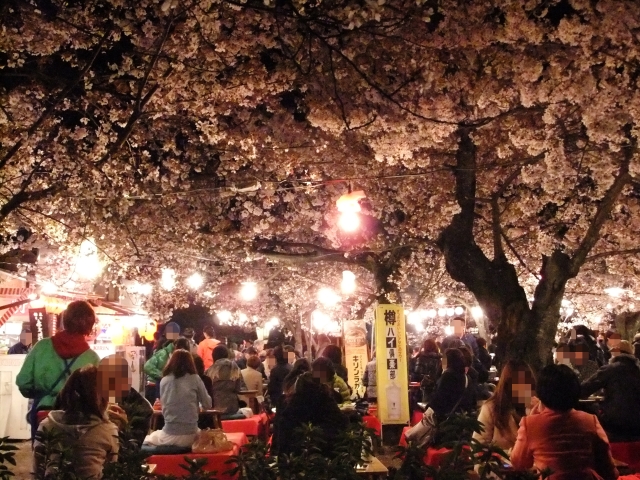
In addition, it may be fun to participate in in Japan’s “Flower Picnic Culture”. During the blooming season of the cherry blossoms, the ground beneath the trees is occupied by many picnic blankets. Sitting below the trees participating in drinking parties or eating a delicious bento (boxed lunch) is part of the “Flower Picnic” event.

Parties are frequently held together with family, friends and colleagues. In countries or states where drinking in only permitted in bars, these parties may seem like a strange scene, but in Japan, it is just another seasonal event. To really experience the Japanese culture, it may be fun to try it at least once. While immersing yourself in the night-time cherry blossoms and the gentle spring breeze, enjoy the Japanese spring to your heart’s content with some close friend.

Sponsor Link

Ramen museum – Enjoy fantastic ramen trip throughout Japan @ Yokohama

One of the most important “mission possible” is – finding your favorite ramen in Japan.

Ramen magazines in the reception

You might secretly take pride in being ramen authority- who has wide range of Japanse ramens’ knowledge. Japanese ramens have a variety of tastes, for example, soup, noodle, seasoning, texture, seasonal special, temperature, qualities, blah blah…don’t showing off your stock of knowledge about ramens before visiting Japan. Furthermore, I promise you are able to boost your ramen knowledge if you stop by tons of ramen shops in Japan. Which flavor of ramen do you like?  醤油Soy source ? 味噌Miso?塩Salt? 豚骨Pork bone broth? 煮干しFish broth? 坦々Spicy bean curd ? Noodles with seasoning混ぜそば?? Cold ramen 冷やし中華?

Basically, we have many regional ramens – like very famous Hakata Tonkotsu ramen (from Fukuoka Prefecture), Sapporo Miso ramen (from Hokkaido), Tokyo shoyu ramen (from Tokyo), Kitakata ramen (from Fukushima Prefecture), Okinawa So-ki soba (Okinawa Prefecture), Hida Takaya ramen (Gifu Prefecture), Onomichi ramen (Hiroshima Prefecture), Nagasaki Champon (Nagasaki Prefecture) ,Yokohama Ie-kei ramen (Kanagawa prefecture) and more. And new ramen tastes and styles are always been created day by day in Japan.

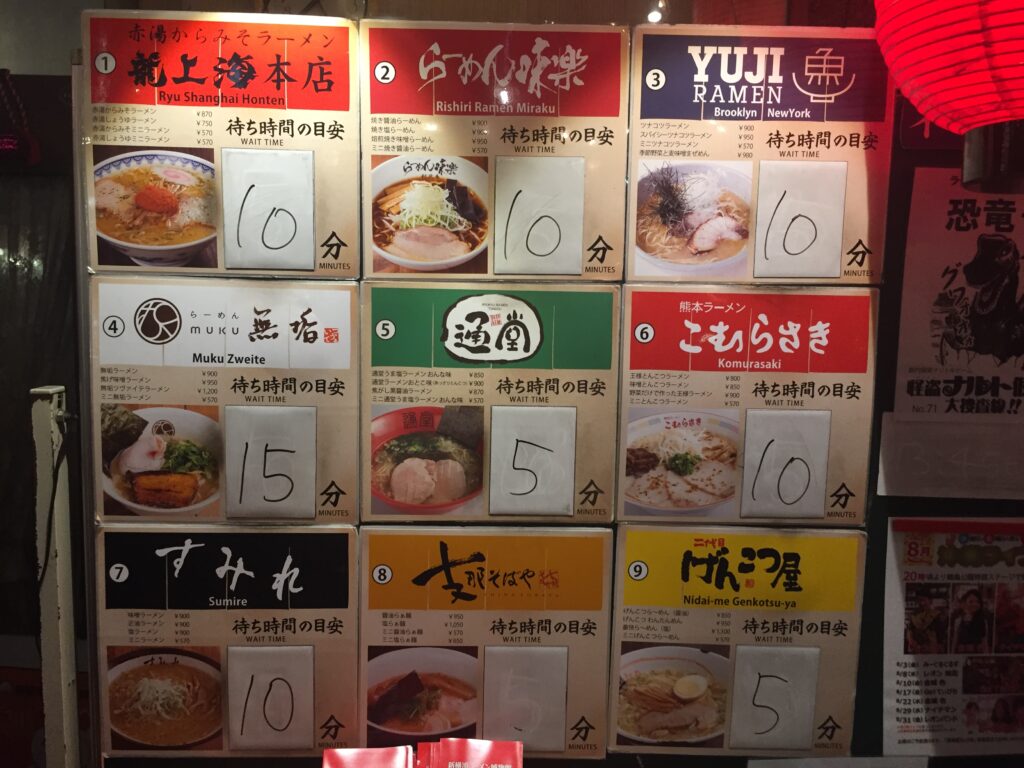
Menu board – with information of approx waiting time

Actually Japanese ramen shops are very competitive. According to Japanese Restaurant Associates 飲食店.com indicates – 40 % of ramen shops are going to close within one year. 70 % ramen shops will also be close their businesses within 3 years. I learned that the reason why I am always at a loss I can’t find the ramen shop that I have been wanting to visit for a long time- It was gone – already out of business before I visit there.

However, we have last ray of hope. There is the Ramen Museum @Shin-yokohama. Yokohama is the suburb area of Tokyo where is located in next to Tokyo 23 wards – only 10 minutes ride will take you Yokohama area. Shin-yokohama station is only one stop from Shinagawa station by Nozomi bullet train (Shinkansen). Local trains are also available from Tokyo station to Yokohama station.

Ramen museum’s concept is Showa-era 1926-1989 revival. After experienced World War Ⅱ, Showa-era of japan is the symbol of post-war reconstruction. It has been said, Japan’s most vibrant era in everything– economy, culture, sports events like Olympics and World Exposition – until Japanese economic collapse (it’s been called “バブル崩壊“bubble burst in 1989).

Ramen museum is featuring, legendary ramen shop which is already physically closed due to owner’s retire, no successor, many reasons – trying to restore the receipt of old style – as it were, nostalgic authentic flavor ramen.

Meanwhile, an up-and-coming ramen shef’s shop is still on the list. We are so lucky we could taste a variety of tasty ramens from North to South area of Japan.

Muku 無垢 ramen

They are also serving half-size ramen, so that we are likely to eat every ramen in the display board! Also ramen shops are roughly rotating every 4 months, you may taste different ramens if you came back 4 months later!!

As of June,2024, the line-ups of Ramen Museum are below the link.

https://www.raumen.co.jp/english/

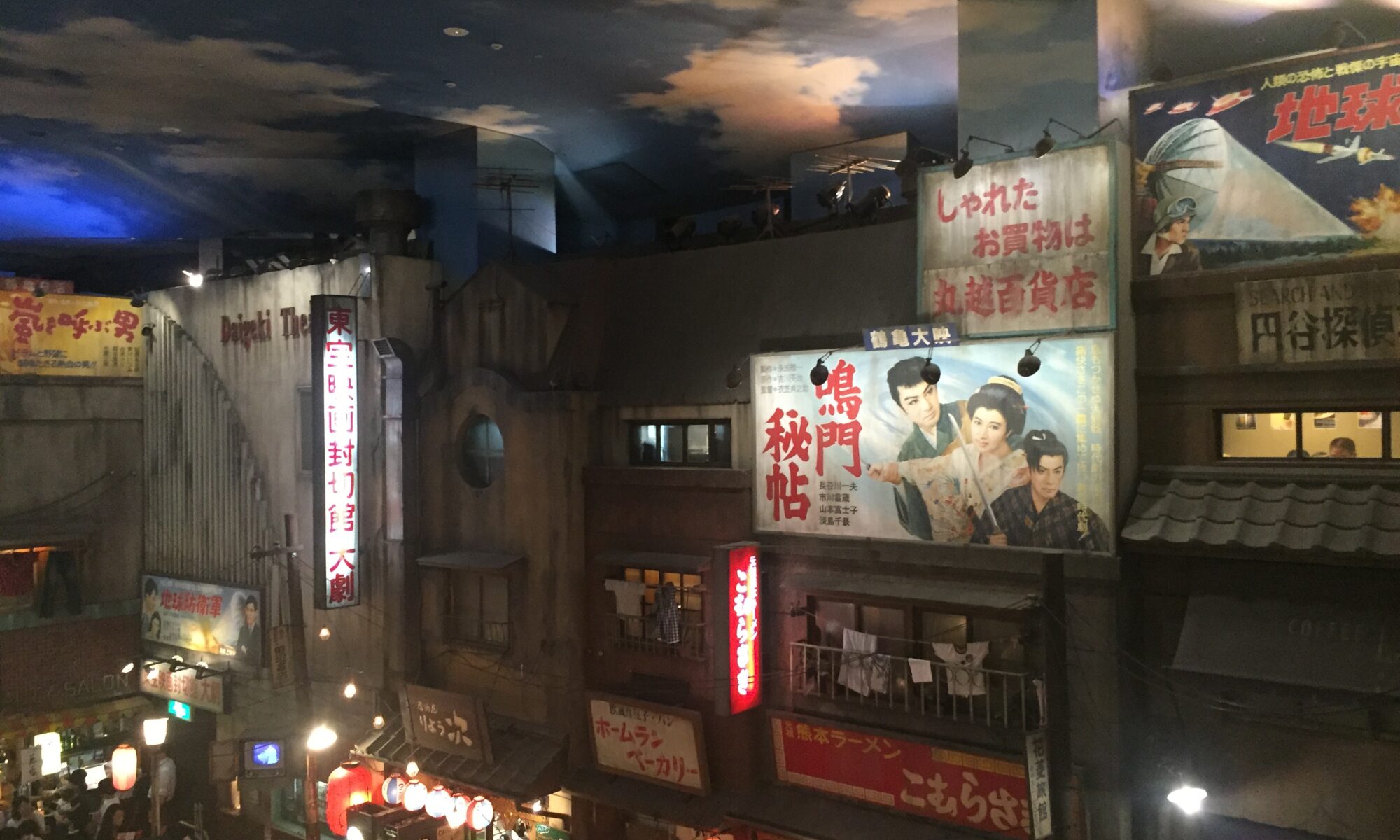
The museum is fully covered with Japanese old movie theaters’ signboards and old-style taverns, shops, stores in everywhere. It is very fun to see around the alleys of the town after you ate many bowls of ramens!

This museum’s atmosphere is also popular among Japanese young generation – because they’ve never seen Japanese Showa scenes like this. It is really new vibes for young people, they must feel “エモい“being emotional while they are in the museum, and must be reminded of something they had forgotton. Perhaps, it has very nostalgic “ナツい”懐かしい“mood for the middle age of Japaneses.

Anyway, you never be disappointed with this museum, and enjoy Yokohama. Chances are you visit famous Yokohama China Town -it is very close to Shin-Yokohama station. Please leave behind your weight-conscious mindset while visiting the gourmet spot!!